Introducing the Degree of Collectivity in Lattice Resonances of Plasmonic Nanoparticle Arrays
- Istituto Italiano di Tecnologia, via Morego 30, 16163 Genova, Italy
- Instituto de Química Física Blas Cabrera (IQF), CSIC, 28006 Madrid, Spain
- Dipartimento di Fisica, Università degli Studi di Genova, via Dodecaneso 33, 16146 Genova, Italy
- Departamento de Óptica, Universidad Complutense de Madrid, 28040 Madrid, Spain
- Departamento de Física de Materiales, Universidad Autónoma de Madrid, 28049 Madrid, Spain
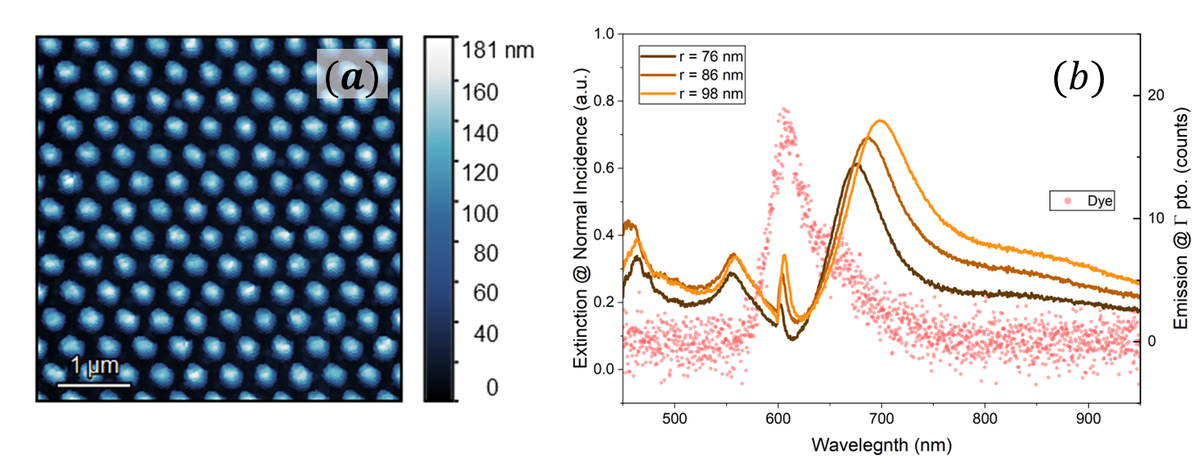
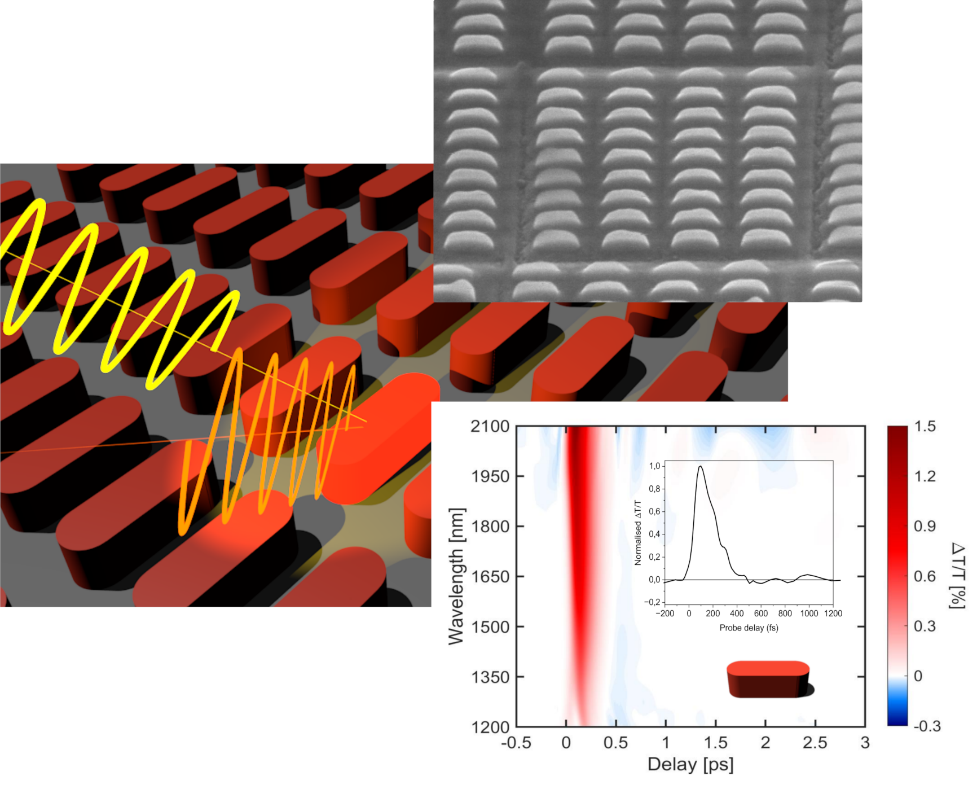
The excitation of localized surface plasmon resonances (LSPRs) on metal nanoparticles (NPs) has attracted much interest due to the possibility to concentrate light in nanometric volumes and reach high near-field enhancement. When NPs are arranged in array with periodicity comparable to the excitation wavelength, in-plane lattice resonance (LR) can emerge from the constructive interference of the individual NP response, showing extremely high Q-factor resonance with respect to the LSPR. As a result, LRs have found applications in many fields of study, including quantum information and photocatalysis [1]. Despite the increasing relevance of LR, a quantitative metric able to describe the strength of the interaction between NPs, and to guide the design of LR-supporting arrays, remains lacking. Here we present the recently introduced "degree of collectivity" [2], an experimentally accessible metric that quantifies the coherence of constructive interactions between NPs. By combining numerical and experimental studies, we demonstrate that higher degree of collectivity corresponds to higher LR quality-factor and NP array robustness against fabrication imperfection. For a more comprehensive understanding, we also evaluate the impact of the finite array size, periodicity imperfection, and environment refractive index on the LR behavior at a given degree of collectivity. Moreover, we experimentally demonstrate that the interplay between two NP arrays enables the excitation of out-of-plane modes at normal incidence [3]. Our results provide a reliable tool to predict the experimental performance and feasibility of actual plasmonic devices relying on LR, thus opening new scenarios in the realization of advanced photonic devices.
Support from the European Research Council under the European Union’s Horizon 2020 Research and Innovation Program through the ERC Consolidator Grant REPLY (Grant Agreement No. 101002422) is acknowledged.
- Kravets, V. G. et al. “Plasmonic surface lattice resonances: a review of properties and applications,” Chem. Rev., Vol. 118, No. 12, 5912–5951, 2018.3.
- Alvarez-Serrano, Juan J., et al. "Conceptualizing collectivity in lattice resonances of periodic arrays of nanostructures." JPhys Photonics 8.1 (2026): 015069
- Alvarez-Serrano, Juan J., et al. "Normal incidence excitation of out-of-plane lattice resonances in bipartite arrays of metallic nanostructures." ACS photonics 11.1 (2023): 301-309.